
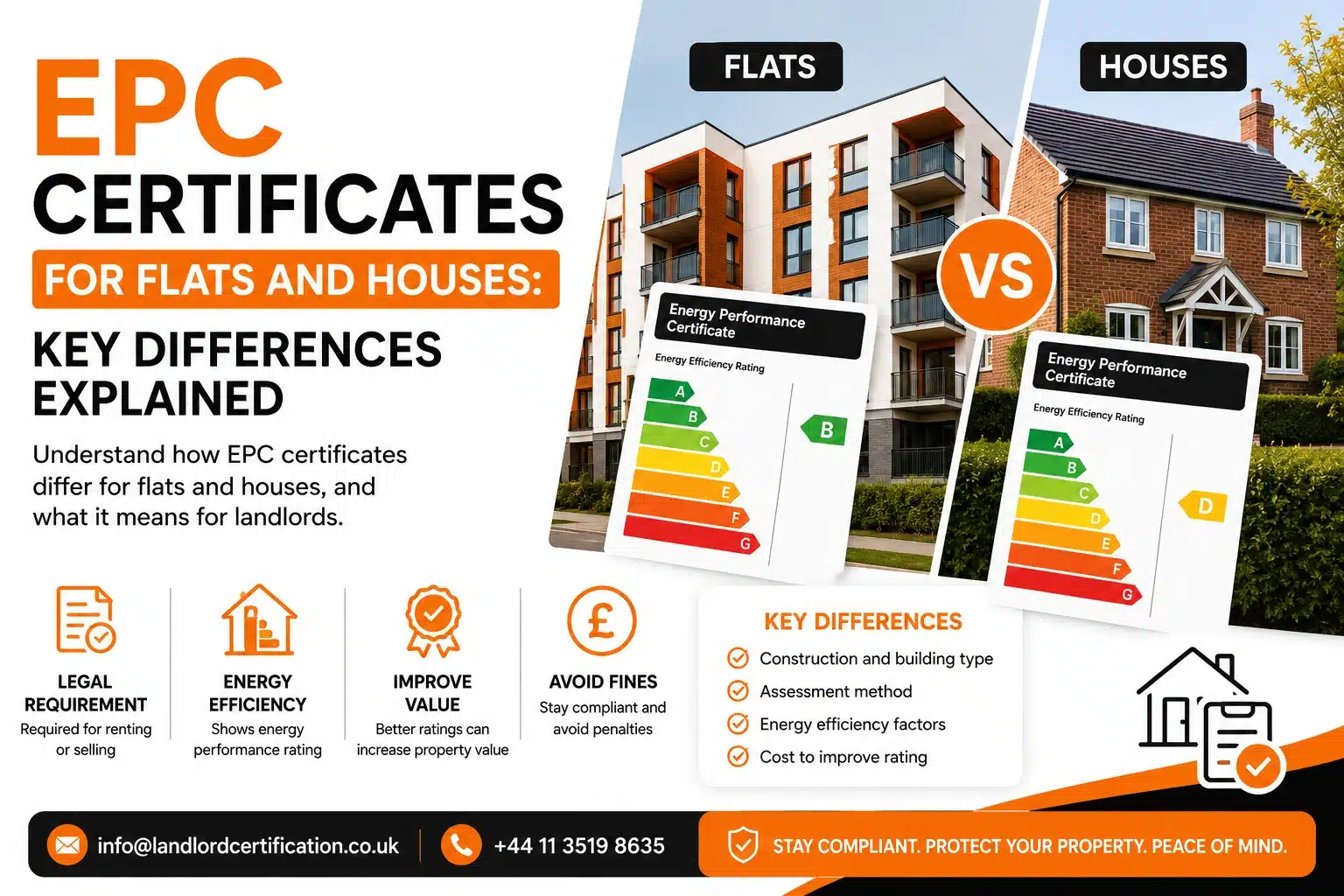
If you’re selling, renting, or simply trying to understand your property’s energy profile, you’ve likely come across the term EPC. But here’s something many people don’t realise: the type of property you own, flat or house, can significantly influence your Energy Performance Certificate rating, even though the legal requirements remain the same.
Whether you’re a landlord deciding between a buy-to-let flat and a house, a homeowner preparing to sell, or a first-time buyer comparing properties, understanding how EPC certificates for flats and houses differ is essential. In this guide, we’ll break down what an EPC actually measures, why flats often score better, where houses typically fall short, and what this means for your compliance obligations and long-term energy costs.

What Is an EPC Certificate?
An Energy Performance Certificate (EPC) is a legal document that rates a property’s energy efficiency on a scale from A (most efficient) to G (least efficient). It provides a snapshot of how much energy a property uses, what the estimated running costs are, and what improvements could be made to boost efficiency.
EPCs are mandatory in the UK whenever a property is sold, rented, or built. The certificate is produced by a qualified, accredited assessor and is valid for 10 years, unless significant energy upgrades are carried out that would warrant a fresh assessment.
Key elements of an EPC include:
- The property’s current and potential energy efficiency rating
- Estimated energy costs for heating, hot water, and lighting
- Environmental impact (CO₂ emissions)
- Tailored recommendations for improvement
Understanding your EPC certificate is the first step toward making informed decisions about energy upgrades, rental compliance, or property investments. For landlords in particular, maintaining a valid EPC certificate isn’t just good practice it’s a legal necessity under current EPC regulations in the UK.
Do Flats and Houses Need Different EPC Certificates?
No, from a legal standpoint, flats and houses are assessed under the same framework. Whether you own a studio apartment or a five-bedroom detached home, you need an EPC before you can market the property for sale or rent. The assessment methodology is consistent, and the certificate itself looks identical regardless of property type.
However, the outcome often differs significantly. A flat’s EPC rating and a house’s EPC rating can vary dramatically, not because the rules are different, but because the building characteristics are. Shared walls, communal heating systems, smaller floor areas, and reduced exposure to external elements all play a role in how energy efficiency is calculated.
So while the legal requirement is universal, both flats and houses need an EPC certificate when sold or rented. The practical reality is that property type heavily influences the score you’ll receive.
Why Flats Often Have Better EPC Ratings Than Houses
It’s a pattern we see consistently across the UK: flats tend to achieve better EPC ratings than houses. There are several structural and practical reasons for this.
Shared Walls Reduce Heat Loss
Flats are typically surrounded by other properties on at least one side, often two or three. These shared walls act as natural insulation, reducing the amount of heat that escapes. A mid-floor flat in a purpose-built block, for example, benefits from the warmth of neighbouring properties above, below, and beside it. In contrast, a detached house has four external walls exposed to the elements, making heat retention far more challenging.
Smaller Floor Area
Energy efficiency ratings are partly based on the cost of heating per square metre. Flats generally have a smaller internal volume than houses, which means less space to heat and lower overall energy demand. A compact one-bedroom flat will almost always cost less to heat per square metre than a sprawling three-bedroom semi-detached house.
Communal Heating Systems
Many modern flats, particularly in purpose-built developments, benefit from communal or district heating systems. These centralised systems are often more efficient than individual boilers, especially when combined with heat recovery or combined heat and power (CHP) technology. A single efficient plant room serving dozens of flats typically outperforms dozens of separate gas boilers in terms of overall efficiency.
Less Exposed Surface Area
Flats, especially those in larger blocks, have less external surface area relative to their internal volume compared to houses. A top-floor flat still has a roof and possibly two external walls, but a ground-floor flat in the same block may only have one external wall and a floor. Houses, by contrast, have roofs, multiple walls, and often larger windows, all of which contribute to heat loss.
Why Houses Sometimes Receive Lower EPC Ratings
If flats have natural advantages, houses often face the opposite set of challenges. Understanding why houses have lower EPC ratings can help owners prioritise the right improvements:
Detached and Exposed Walls
Detached houses are entirely surrounded by external air. Every wall is a potential source of heat loss. Even semi-detached and terraced homes, while better than detached properties, still have more exposed surface area than the average flat. Solid brick walls, common in pre-1919 houses offer minimal insulation compared to modern cavity walls.
Roof Exposure
Heat rises, and in houses, that heat escapes straight through the roof. Unless a property has effective loft insulation (270mm or more of mineral wool is the current recommendation), a significant portion of energy is wasted. Many older houses still have inadequate or degraded loft insulation, dragging down the EPC score.
Older Construction
The UK housing stock is among the oldest in Europe. Millions of houses were built before modern building regulations introduced requirements for cavity wall insulation, double glazing, and efficient boilers. A Victorian terraced house with original sash windows, a solid fuel back boiler, and no wall insulation will almost inevitably score a D, E, or even F.
Heating Inefficiencies
Houses are more likely to rely on older, less efficient heating systems. A 15-year-old gas boiler operating at 70% efficiency compares poorly to a modern condensing boiler running at 90%+. Larger homes also require more powerful heating systems, and if these are outdated, the energy penalty is magnified.
Larger Internal Space
Simply put, bigger homes require more energy to heat. A four-bedroom detached house with high ceilings and multiple reception rooms will always have higher energy demands than a two-bedroom flat. Even with good insulation, the sheer volume of space works against the EPC rating.
How EPC Assessments Differ Between Flats and Houses
While the legal framework is the same, the practical assessment process can vary between flats and houses. An accredited EPC assessor will evaluate the same core elements in both cases, walls, roofs, floors, windows, heating, lighting, and hot water.
Loft Access
In a house, the assessor will typically inspect the loft to check insulation depth and type. In a flat, especially a mid-floor unit, there may be no loft to assess. The roof insulation is either communal (and accounted for in the block’s overall assessment) or not applicable. This can simplify the assessment but also means the flat benefits, or suffers, from decisions made by the freeholder or management company.
Heating Systems
Houses are assessed on their individual boilers, radiators, and controls. Flats may have individual systems (especially in conversions) or communal systems. Where heating is communal, the assessor will need information about the system’s efficiency, which is sometimes harder to obtain if the managing agent is uncooperative.
Wall Insulation
Houses with cavity walls can be straightforward to assess the assessor checks for insulation fill. Flats in converted houses often have solid walls, and determining whether these have been internally or externally insulated can be difficult, especially in leasehold properties where alterations may be restricted.
Shared Services and Communal Areas
In blocks of flats, corridors, stairwells, and shared facilities are generally excluded from individual EPC assessments. However, the efficiency of communal lighting, lifts, and ventilation can indirectly affect the flat’s energy profile, particularly where heating is partially drawn from communal systems.
Access Restrictions
Assessors sometimes face access challenges in flats particularly in high-rise buildings with security entry systems or where the managing agent must grant permission. This doesn’t affect the rating itself, but it can delay the assessment process.
EPC Requirements for Rental Flats and Houses
For landlords, the EPC isn’t just a box-ticking exercise it’s a critical compliance document. Under the Minimum Energy Efficiency Standards (MEES), it is unlawful to let a property with an EPC rating below E (unless a valid exemption is registered).
This applies equally to flats and houses. Whether you’re letting a one-bedroom leasehold flat or a five-bedroom detached house, you must:
- Provide a valid EPC to prospective tenants before they sign a tenancy agreement
- Ensure the property meets at least an E rating (or register an exemption)
- Renew the EPC if it expires during a tenancy
MEES Regulations and Landlord Obligations
The MEES regulations were introduced in 2018 and have been progressively tightened. From 2025, all newly rented properties will need a minimum C rating, and from 2028, this will apply to all existing tenancies as well. While these dates have been subject to political debate, the direction of travel is clear: landlords must improve energy efficiency or face restrictions on letting.
For landlords of flats, the challenge often lies in leasehold restrictions. You may want to install external wall insulation or replace windows, but the freeholder or management company may refuse permission. In houses, you generally have more autonomy but also a larger, more expensive property to upgrade.
Understanding EPC compliance for rental properties is essential for avoiding penalties and maintaining a lettable portfolio. If you’re unsure whether your property meets the minimum EPC rating for landlords, a professional assessment is the only way to be certain.
Common EPC Problems in Flats vs Houses
Every property has its weak points. Here are the issues we most commonly encounter when assessing flats and houses across London and the UK.
Common Problems in Flats
Electric Heating: Many older flats, particularly conversions, rely on electric panel heaters or outdated storage heaters. Electric heating is inherently less efficient than gas central heating in EPC calculations, and unless the system is modern and well-controlled, it can drag a rating down to D or E.
Poor Ventilation: Flats are often less well-ventilated than houses. Condensation and mould issues can lead to sealed windows and extractor fans that are either absent or ineffective. Poor ventilation doesn’t directly affect the EPC score, but it can lead to damp problems that necessitate energy-intensive solutions.
Older Converted Buildings: Victorian and Edwardian houses converted into flats often retain original features, single-glazed sash windows, solid walls, and high ceilings. While charming, these features are energy inefficient. Ground-floor flats in particular may suffer from cold floors and rising damp.
Common Problems in Houses
Solid Walls. Approximately one-third of UK homes have solid walls. Without internal or external insulation, these properties leak heat. Solid wall insulation is one of the most effective EPC improvement measures, but it’s also one of the most expensive and disruptive.
Old Boilers. A boiler over 15 years old is likely operating at 60–70% efficiency. Upgrading to a modern condensing boiler can improve an EPC rating by several bands. Yet many homeowners delay this upgrade due to cost, only to discover the issue when they come to sell or let.
Roof Insulation Issues. Inadequate, compressed, or absent loft insulation is one of the quickest ways to a poor EPC rating. It’s also one of the cheapest fixes but many homeowners are unaware of what lies above their ceiling.
How to Improve EPC Ratings for Flats and Houses
The good news is that most properties can be improved. The approach differs depending on whether you own a flat or a house, largely due to structural constraints and ownership rights.
Improvements for Flats
Smart Heating Controls. Installing thermostatic radiator valves (TRVs), programmable thermostats, and smart heating controls can improve your EPC rating without major structural work. These measures demonstrate to the assessor that heating is being used efficiently.
LED Lighting. Replacing all remaining halogen or incandescent bulbs with LED equivalents is a simple, low-cost improvement that contributes to a better rating. It won’t transform a G into a C, but every point counts.
Secondary Glazing. For flats in listed buildings or conservation areas where double glazing isn’t permitted, secondary glazing offers a viable alternative. It reduces heat loss through windows and improves the EPC score without altering the property’s external appearance.
Draught-Proofing. Sealing gaps around windows, doors, and pipework is inexpensive and effective. In older flats with original features, professional draught-proofing of sash windows can make a noticeable difference.
Improvements for Houses
Insulation. This is where houses have the most to gain. Loft insulation, cavity wall insulation, and solid wall insulation are the three pillars of domestic energy efficiency. Even partial improvements such as topping up loft insulation from 100mm to 270mm — can shift a rating by one or two bands.
Boiler Upgrades. Replacing an old boiler with a modern A-rated condensing model is one of the single most impactful improvements for houses. For larger properties, the energy savings alone can justify the investment within a few years.
Solar Panels. While a significant upfront investment, solar photovoltaic (PV) panels can dramatically improve a property’s EPC rating and reduce running costs. They’re particularly effective on south-facing roofs with minimal shading a common feature of detached and semi-detached houses.
Double or Triple Glazing. Upgrading from single to double glazing, or from old double glazing to modern low-emissivity (low-E) units, reduces heat loss and improves comfort. For houses with large window areas, this can be transformative.
Floor Insulation. In houses with suspended timber floors common in Victorian and Edwardian properties, insulating between the joists can reduce draughts and heat loss. This is often overlooked but can contribute meaningfully to the EPC score.
EPC Exemptions for Flats and Certain Buildings
Not every property requires an EPC, and some are exempt from the MEES minimum rating requirements. It’s important to understand these exemptions, particularly for landlords and owners of non-standard properties.
Listed Buildings
Listed buildings are not automatically exempt from EPC requirements, but they may qualify for an exemption if the recommended energy efficiency improvements would unacceptably alter their character or appearance. This is assessed on a case-by-case basis, and the exemption must be registered on the official PRS Exemptions Register.
Leasehold Complications
Leasehold flats can present unique challenges. If you’re a leaseholder wanting to improve your property’s EPC rating, you may need freeholder consent for works such as external wall insulation, window replacement, or boiler upgrades. Where consent is unreasonably withheld or delayed, you may be able to register a temporary exemption but this requires documentation and can be a lengthy process.
Conservation Areas
Properties in conservation areas face similar restrictions to listed buildings. External alterations including solar panels, external wall insulation, and window replacements may require planning permission or conservation area consent. If these improvements are blocked, an exemption may be available.
Other Exemptions
Temporary buildings used for less than two years, stand-alone buildings with total useful floor space of less than 50 square metres, industrial sites and workshops with low energy demand, and buildings due to be demolished may all qualify for exemption.
If you believe your property may qualify for an exemption, professional advice is recommended. Incorrectly assuming an exemption can lead to enforcement action and fines.
Which Is Better for Landlords: Flats or Houses from an EPC Perspective?
There’s no universal answer, it depends on your investment strategy, budget, and risk appetite. Here’s how flats and houses compare from an EPC and energy efficiency standpoint.
Average EPC Rating. Flats typically achieve better ratings (C–D average) while houses are more variable (D–E average for older stock).
Heat Loss. Flats experience lower heat loss due to shared walls. Houses suffer higher heat loss due to exposed surfaces on all sides.
Improvement Flexibility. Flats are limited by leasehold restrictions. Houses offer greater autonomy for upgrades.
Upgrade Costs. Flats generally require lower investment due to smaller scale. Houses demand higher spending due to larger areas and more systems.
Communal Systems. Flats may benefit from efficient communal heating, though this can also cause complications. Houses rely entirely on individual systems.
MEES Compliance. Flats are often easier to bring to an E rating or above. Houses may require significant investment to comply.
Future-Proofing. Flats carry risk of stranded assets if the block doesn’t upgrade. Houses offer more control over the upgrade timeline.
The Case for Flats
Flats often start from a better EPC baseline. A modern purpose-built flat with communal heating may already meet the proposed C-rating target for 2025/2028 without any landlord investment. The smaller size means lower energy bills for tenants, making the property more attractive to rent. However, leasehold restrictions can prevent you from making necessary improvements if the rating slips.
The Case for Houses
Houses offer more control. You can insulate walls, replace the boiler, install solar panels, and upgrade windows without seeking freeholder permission. This flexibility is valuable as EPC requirements tighten. The downside is that older houses often need substantial investment to reach a C rating potentially £10,000 or more for solid wall insulation, boiler replacement, and glazing upgrades.
The Bottom Line for Landlords
If you’re buying new stock with EPC compliance in mind, modern flats in well-managed blocks currently offer the path of least resistance. If you’re holding older houses, budget for upgrades now waiting until 2028 will only increase costs and reduce your pool of eligible tenants.
Conclusion
Whether you own a flat or a house, an EPC certificate is an unavoidable part of property ownership in the UK. The legal requirement is the same for both: you need a valid EPC to sell or rent. But the ratings, challenges, and improvement strategies differ significantly.
Flats benefit from shared walls, smaller spaces, and communal heating, advantages that often translate into better EPC ratings with less effort. Houses, particularly older detached and semi-detached properties, face greater exposure to the elements, larger heating demands, and the burden of outdated construction. Yet houses also offer more freedom to upgrade, which may prove decisive as MEES regulations tighten toward a minimum C rating.
For landlords, understanding these differences isn’t academic, it’s financial. A property that can’t meet future EPC standards becomes unlettable. A property that exceeds them becomes more attractive, more valuable, and more future-proof.
If you’re unsure where your property stands, the first step is simple: get a professional EPC assessment from an accredited provider. At EPC Certs, our qualified assessors evaluate all property types across London and the UK, delivering accurate ratings, clear guidance, and practical recommendations whether you own a studio flat or a six-bedroom house.