
PAT testing does not have a fixed legal testing interval in England. The appropriate frequency depends on the type of appliance, how often it is used, the environment in which it operates and its condition. Landlords and businesses should use these factors to establish a suitable inspection and testing programme.
For landlords, this distinction is important. UK law requires electrical equipment supplied with a rental property to be safe, but it does not require every portable appliance to undergo PAT testing london every year. The recommended approach is based on the level of risk and the condition of the equipment.
Is There a Legal PAT Testing Frequency?
PAT testing does not have one legally prescribed testing interval for all equipment in England. This is one of the most important points for landlords and business owners to understand. The government states that landlords must ensure electrical equipment supplied with a rental property is safe. The requirement focuses on the safety of the equipment rather than imposing an annual PAT test for every appliance.
The Electrical Safety Standards in the Private Rented Sector (England) Regulations 2020 introduced specific requirements for fixed electrical installations in privately rented properties. Private landlords must arrange an inspection and test of the electrical installation at least every five years.
This essential point relates to the fixed installation and is normally demonstrated through an electrical installation condition report (EICR). This requirement relates to the fixed installation and is normally demonstrated through an Electrical Installation Condition Report, or EICR. It should not be confused with portable appliance testing.
Why PAT Testing Does Not Have a Fixed Annual Interval
Electrical equipment does not experience the same level of wear in every situation. A laptop charger used occasionally in a private office faces different conditions from a kettle used repeatedly in a busy HMO kitchen.
The IET’s Code of Practice for In-Service Inspection and Testing of Electrical Equipment takes this difference into account. Its guidance supports a risk-based programme rather than a blanket testing interval for all appliances.
Various factors can influence the proper frequency. These include how often an appliance is used, who uses it, where it is located and the likelihood of damage. Previous inspection results can also offer useful evidence. This means accountable landlords should evaluate their appliances instead of simply booking an annual test because they have done so.
What Determines How Often PAT Testing Should Be Done?
Type of Electrical Equipment
Different appliances present different risks. Some equipment has exposed components or operates in conditions that can increase the likelihood of damage.
For example, portable appliances used in kitchens may experience heat, moisture and frequent handling. Equipment used on construction sites may face dust, impact and harsh working conditions. By contrast, office equipment may remain in a controlled indoor environment with limited movement.
Frequency of Use
An appliance used several times every day may experience more wear than equipment used once or twice a month. High-use appliances deserve particular attention. Repeated movement, plugging and unplugging can place additional strain on cables, plugs and connections.
A landlord managing an HMO may therefore need to monitor shared kitchen appliances more closely than equipment in a low-use residential property.
Working Environment
The atmosphere can noticeably affect electrical equipment. Heat, moisture, dust and physical impact can all increase the risk of damage. Commercial kitchens, workshops, construction sites and some outdoor environments can expose appliances to more demanding conditions.
Equipment used in these settings may require more frequent inspection than appliances kept in clean, dry office environments.
Previous Inspection Results
Previous PAT results can help determine future inspection intervals. If equipment repeatedly passes inspection and remains in good condition, a competent person may recommend a longer interval. If an appliance develops faults regularly, closer inspection may be appropriate. A testing programme should therefore evolve as the condition and use of equipment change.
Users of the Equipment
The people using electrical equipment can also influence risk. Equipment in a controlled workplace may receive careful handling. Appliances in shared accommodation can experience much heavier use by multiple people.
This does not mean that tenants or employees will necessarily misuse equipment. It simply means that the number of users and the way equipment is handled can form part of a sensible risk assessment.
How Often Should Landlords Arrange PAT Testing?
Private landlords should not assume that every portable appliance requires an annual PAT test. Instead, they should assess the equipment they provide and establish an appropriate inspection programme.
A landlord may choose to arrange regular professional testing as part of their property management process. This can be particularly useful when a property contains several landlord-supplied appliances.
HMOs can require greater attention because shared kitchens and communal facilities often contain heavily used equipment. A landlord should also consider the condition of appliances whenever tenants change.
Routine visual checks provide another important layer of protection. Landlords, property managers and tenants should report damaged cables, cracked plugs, burn marks or other obvious defects as soon as they appear.

PAT Testing for HMOs
HMOs often have a higher concentration of portable electrical equipment than individual rental homes. A shared kitchen may contain several appliances that tenants use throughout the day. Kettles, microwaves, toasters and other equipment can experience considerable wear.
The landlord should keep a clear record of the appliances supplied. Regular visual inspections can help identify damage between formal testing appointments. A risk assessment can then determine how frequently professional inspection and testing should take place. The appropriate interval may be shorter for heavily used equipment.
For landlords managing several HMOs, a planned testing schedule can also simplify property management. Each appliance can have an identifiable record, making it easier to monitor its condition and testing history.
PAT Testing in Offices and Businesses
Businesses also need to consider the condition and use of electrical equipment.
An office may contain computers, monitors, printers, chargers, kitchen appliances and extension leads. Many items remain stationary and operate in relatively controlled conditions. This may result in a lower risk than equipment used in industrial or construction environments. However, businesses still need to manage electrical safety appropriately.
The Electricity at Work Regulations 1989 require precautions to prevent danger from electrical systems at work. The Health and Safety Executive advises employers to maintain electrical equipment so that it remains safe to use. Businesses should therefore use risk assessment to determine an appropriate inspection and maintenance programme.
When Should an Appliance Be Checked Earlier?
A scheduled PAT test should not be the only time someone checks an appliance. An appliance should receive attention sooner if someone notices visible damage or a change in its performance. Warning signs can include a damaged cable, cracked plug, burn marks, unusual smells or signs of overheating. Equipment that has suffered impact or exposure to water may also require assessment before it returns to service.
If an appliance develops a fault, the safest approach is to stop using it until a competent person assesses the problem. Do not continue using an appliance simply because its last PAT test was recent. A certificate records the condition of equipment at the time of inspection. It does not guarantee that an appliance will remain safe indefinitely.
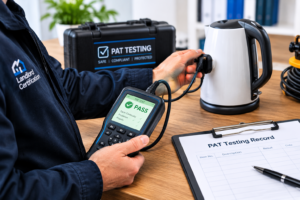
What Happens During a Professional PAT Test?
A professional inspection normally begins with a visual examination.
- The engineer checks the appliance, plug, cable and casing for visible defects. They can identify problems such as damaged insulation, cracked plugs or signs of overheating.
- Where appropriate, the engineer then carries out electrical tests using suitable equipment. The exact tests depend on the appliance’s construction and classification.
- The IET Code of Practice provides guidance on selecting suitable inspection and testing procedures. It recognises that not every item requires identical testing.
- The results should be recorded against individual appliances. This creates a useful asset record for landlords and businesses.
What Happens When an Appliance Fails?
A failed appliance should not simply be returned to use.
The engineer should identify the reason for the failure and record the result. Depending on the fault, the appliance may need repair, further assessment or replacement. Landlords should ensure that unsafe equipment is removed from service until the problem has been resolved.
If an appliance is repaired, it may need to undergo appropriate inspection and testing before someone puts it back into use. The resulting record should reflect the work carried out and the subsequent test result. This process creates a clearer safety trail and helps prevent defective equipment from remaining in service.
Does PAT Testing Replace an EICR?
No, PAT testing and EICR testing examine different parts of a property’s electrical system.
An EICR assesses the fixed electrical installation. This includes fixed wiring, sockets, switches, consumer units and other relevant components. Whereas PAT testing focuses on portable electrical equipment. This can include appliances supplied by a landlord or used within a workplace.
Private landlords in England must arrange an inspection and test of the fixed electrical installation at least every five years. A landlord should therefore understand both responsibilities. Completing an EICR does not automatically mean that portable appliances have been inspected.
Choosing Professional PAT Testing Services in London
A professional provider should explain how it approaches inspection and testing. Avoid choosing a company simply because it promises an annual certificate at the lowest price. Ask what the service includes and how the provider records individual appliances. You should also confirm the qualifications and experience of the person carrying out the work.
Landlord Certification provides portable appliance testing across London and the M25 area. Its engineers are qualified to City & Guilds 2377 standards and use the IET 5th Edition Code of Practice as the basis for its testing approach.
The service includes visual inspection, electrical testing where appropriate, appliance identification, pass or fail labelling and digital certification. The company also provides risk-based recommendations rather than applying one fixed testing interval to every property. You can view the service details through Landlord Certification’s PAT Testing London service.
Final Thoughts
PAT testing does not follow one compulsory annual timetable for every appliance in England. The appropriate frequency depends on risk.
Landlords and businesses should consider the type of equipment, frequency of use, working environment, likelihood of damage and previous inspection results. They should also carry out sensible visual checks between professional inspections.
For landlords, portable appliance safety forms part of a wider responsibility to provide safe electrical equipment. The fixed electrical installation has separate inspection requirements, including the five-year requirement for private rented properties in England.